

The “You have a package waiting” phishing email is a scam that attempts to obtain personal information, login credentials, and potentially payment details by impersonating a parcel delivery notification. It claims that a delivery attempt was unsuccessful and that the recipient must arrange another delivery to receive their package. The supposed shipment problem is used to direct recipients to a deceptive website.
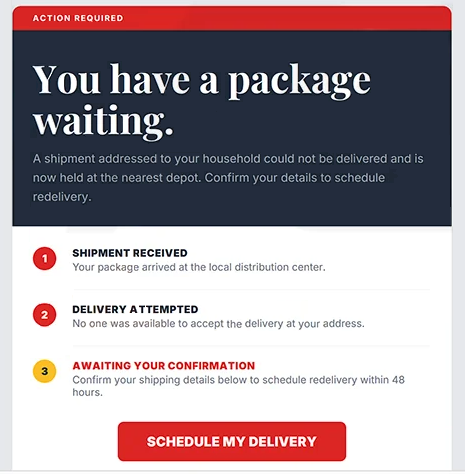
The phishing email uses the subject line “Your package is waiting for pickup” to create the appearance of a legitimate delivery notification. It states that a parcel addressed to the recipient’s household has been transferred to a nearby distribution depot because nobody was available to receive it. However, the email does not identify the courier company responsible for the shipment.
To make the claim more convincing, the phishing email includes a three-stage delivery timeline. It indicates that the package arrived at a local distribution center, that a delivery attempt was made, and that further confirmation is required. These details give the impression that the shipment is being tracked, even though no independently verifiable delivery information is provided.
Recipients are instructed to click a button labeled “SCHEDULE MY DELIVERY” and confirm their shipping details within 48 hours. The email also warns that packages remaining unclaimed for five business days will be returned to the sender. These deadlines are intended to encourage recipients to act quickly rather than question whether the package exists.
The button leads to a phishing website designed to collect sensitive information. Depending on the page displayed, visitors may be asked to provide their names, addresses, telephone numbers, email credentials, or payment details. The destination website was no longer accessible when examined, so its complete functionality could not be established.
Information submitted through such websites can be exploited in different ways. Stolen email credentials may allow scammers to access private correspondence, impersonate account owners, or attempt password resets for other services. Personal information could be used in additional scams, while compromised payment details may enable unauthorized transactions.
The “You have a package waiting” phishing email is not a legitimate delivery notification. Its purpose is to exploit recipients’ expectations of receiving parcels and persuade them to disclose sensitive information through an untrustworthy website.
The full “You have a package waiting” phishing email is below:
Subject: Your package is waiting for pickup
ACTION REQUIRED
You have a package waiting.
A shipment addressed to your household could not be delivered and is now held at the nearest depot. Confirm your details to schedule redelivery.
1 Shipment received
Your package arrived at the local distribution center.2 Delivery attempted
No one was available to accept the delivery at your address.3 Awaiting your confirmation
Confirm your shipping details below to schedule redelivery within 48 hours.[SCHEDULE MY DELIVERY]
Packages unclaimed after 5 business days are returned to sender.
Unsubscribe | Opt out
How to recognize phishing emails
The “You have a package waiting” phishing email contains several warning signs, beginning with the absence of a recognizable courier company. Although it claims that a package is being held at a distribution depot, it does not identify the organization responsible for transporting or delivering it. This makes the supposed shipment difficult to verify.
Another suspicious detail is the lack of specific information about the parcel. The email refers to a delivery addressed to the recipient’s household but does not identify the sender or provide a complete delivery address. The shipment reference may look official, but a reference number alone does not prove that a genuine delivery exists.
The three-stage shipment timeline is another element intended to establish credibility. It presents the package as having arrived at a local facility, undergone an unsuccessful delivery attempt, and entered a confirmation stage. However, these status updates are not supported by tracking information from an identifiable delivery service.
The 48-hour confirmation deadline is also a warning sign. By suggesting that recipients must act quickly to arrange delivery, the phishing email creates unnecessary pressure. The additional warning that the package will be returned after five business days reinforces the impression that immediate action is required.
The “SCHEDULE MY DELIVERY” button is particularly important because it directs recipients to an unrelated website. A phishing page may resemble a legitimate courier service while requesting personal information or payment details. In some cases, it may display a counterfeit email login form, which is especially suspicious because rescheduling a parcel delivery should not require entering an email account password.
The email also includes “Unsubscribe” and “Opt out” options. These elements are more commonly associated with promotional emails than notifications concerning individual shipments. Their presence does not automatically establish phishing, but it is another detail worth considering alongside the unidentified courier and unverifiable delivery claim.
The combination of an unspecified delivery company, a generic shipment reference, urgent confirmation deadlines, and a button leading to an unfamiliar website distinguishes the “You have a package waiting” phishing email as an attempt to obtain sensitive information.
Site Disclaimer
2-remove-virus.com is not sponsored, owned, affiliated, or linked to malware developers or distributors that are referenced in this article. The article does not promote or endorse any type of malware. We aim at providing useful information that will help computer users to detect and eliminate the unwanted malicious programs from their computers. This can be done manually by following the instructions presented in the article or automatically by implementing the suggested anti-malware tools.
The article is only meant to be used for educational purposes. If you follow the instructions given in the article, you agree to be contracted by the disclaimer. We do not guarantee that the artcile will present you with a solution that removes the malign threats completely. Malware changes constantly, which is why, in some cases, it may be difficult to clean the computer fully by using only the manual removal instructions.