

European governments are advancing new digital policy measures that combine stricter age verification requirements with discussions around limiting the use of virtual private networks, according to recent reporting and policy developments.
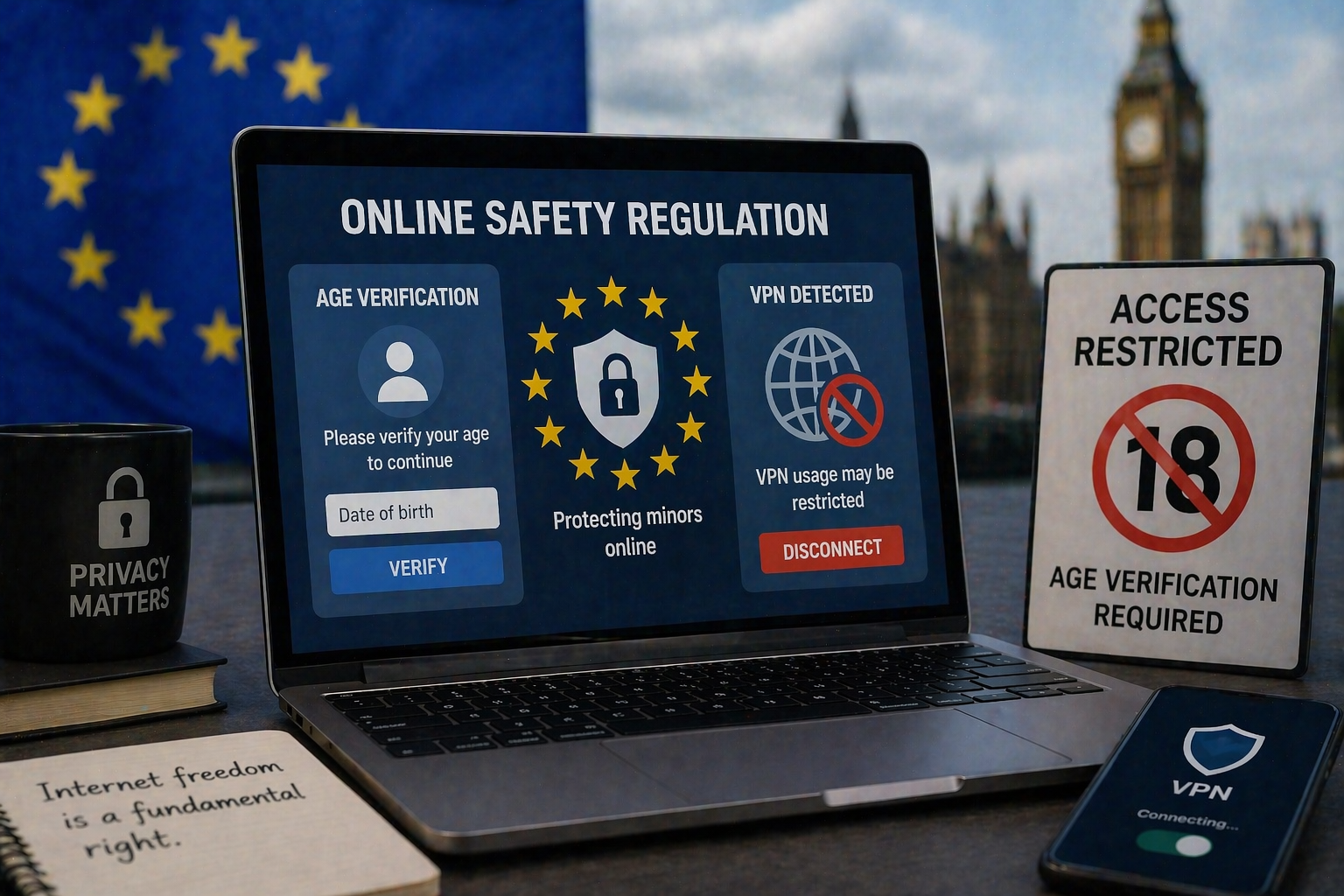
Several countries, including the United Kingdom, France, and Spain, are introducing or expanding rules that require users to verify their age before accessing certain online services. These measures are positioned as part of broader efforts to restrict minors’ access to specific types of content and platforms.
At the European Union level, authorities are also preparing a coordinated approach to age verification. An EU-backed system is being developed to allow users to confirm their age using identification documents such as passports or national IDs. The system is intended to be used across platforms and services that require age checks.
In parallel, policymakers are examining how users bypass these restrictions. Virtual private networks, commonly used to mask location or access restricted content, have become a focal point in these discussions. Some proposals consider extending age verification requirements to VPN services themselves, which would require users to identify their age before using such tools.
The debate includes how responsibility for enforcement is distributed. Industry representatives have stated that platforms already collect sufficient user data to estimate age and location, while infrastructure-level controls, such as VPN restrictions, may introduce additional technical and operational challenges.
Technical limitations of age verification systems have also been noted in research and policy discussions. Reports indicate that such systems can be bypassed using publicly available images or alternative methods, raising questions about their reliability in preventing access.
Separate analysis has identified that many age verification providers store user data, including images and personal identifiers, as part of the verification process. This creates additional data handling requirements and expands the volume of sensitive information stored by third parties.
The policy direction reflects a broader shift toward regulating not only online platforms but also the underlying systems that enable internet access. This includes infrastructure-level components such as authentication services and network routing tools.
Legislative activity remains ongoing, with no unified framework adopted across all EU member states. National governments continue to develop their own approaches, while EU institutions work toward coordination mechanisms that could standardise enforcement across the region.