

The “Temu – Pending Package Delivery” phishing email impersonates Temu and uses a supposedly waiting parcel to draw recipients into a multi-stage scam. Rather than immediately displaying a form for personal information, the campaign first takes users through fake delivery steps intended to make the process resemble genuine parcel tracking.
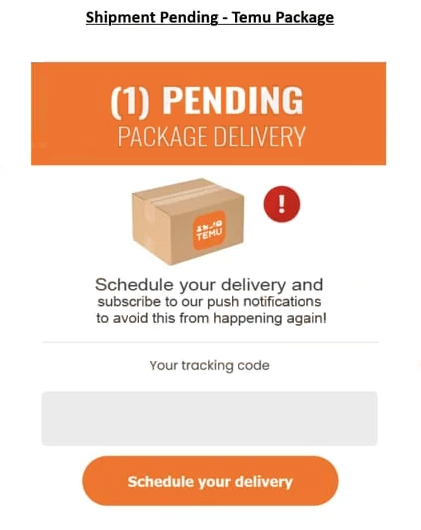
The email arrives with the subject “Attn: Please confirm your shipping-address”. Its main warning states that there is a “PENDING PACKAGE DELIVERY” and suggests that the recipient needs to schedule delivery of the parcel.
Recipients are encouraged to select “Schedule your delivery”. The email also mentions subscribing to push notifications as a way to prevent similar delivery problems in the future. None of these instructions are part of a legitimate Temu delivery process.
Selecting the delivery button opens another page instead of an authentic Temu shipment tracker. This page displays a fabricated shipping-history map and asks the visitor to select “Confirm” to access a message.
The page also requests permission to send browser notifications. Allowing these notifications can result in deceptive advertisements being delivered through the browser. Such notifications may promote additional scams or lead users to other fraudulent websites.
The process continues after “Confirm” is selected. Visitors are presented with several questions before eventually being redirected to a phishing page requesting personal information.
The form asks for the victim’s first and last name, address, postal code, city, telephone number, and email address. These details can be valuable to scammers because they can be used for identity-related fraud or incorporated into further targeted scams.
The analyzed source also indicates that the page is likely to request credit card information. However, this was not established with the same certainty as the personal-information fields, so payment-card collection should not be treated as a confirmed feature of every version of this campaign.
Temu has no involvement in the scam. Its name is used as a disguise to make the fictional package and delivery process appear credible.
The full “Shipment Pending – Temu Package” phishing email is below:
Subject: Attn: Please confirm your shipping-address
Shipment Pending – Temu Package
(1) PENDING PACKAGE DELIVERY
Schedule your delivery and subscribe to our push notifications to avoid this from happening again!
Your tracking code:
–
Schedule your delivery
How to recognize the “Temu – Pending Package Delivery” phishing email
This scam does not rely on a simple “your package is delayed” warning. It creates a sequence of delivery-related interactions that can make the recipient feel as though they are progressing through an actual shipment-management process.
The first clue is the unexpected request to confirm a shipping address. Someone who has recently ordered from Temu may find the subject particularly convincing, but the existence of a real order does not establish that the email is connected to it.
The tracking code can reinforce that impression. A code looks specific, but recipients should verify shipment information through their actual Temu account rather than assuming that a tracking identifier supplied in an unsolicited email is genuine.
The request to subscribe to push notifications is another notable feature. Confirming a shipping address should not require granting an unfamiliar website permission to deliver browser notifications. Notification permissions can persist after the original page is closed and can subsequently be abused to display misleading content.
The fake shipping-history map adds another layer to the deception. After selecting “Schedule your delivery”, recipients are not taken directly to an official Temu order or tracking page. Instead, they encounter a separate process that asks them to select “Confirm”, answer questions, and eventually provide personal information.
This progression is important when identifying the scam. A delivery update gradually becomes a request for the recipient’s name, home address, postal code, city, telephone number, and email address.
Users expecting a Temu package can bypass the entire process described in the email. Opening Temu independently and checking the relevant order provides a safer way to determine whether there is genuinely a delivery issue.
Anyone who has submitted personal information through the phishing site should be cautious about subsequent emails, calls, or other contact using those details. If payment information was also supplied, the affected bank or card issuer should be contacted promptly.
Site Disclaimer
2-remove-virus.com is not sponsored, owned, affiliated, or linked to malware developers or distributors that are referenced in this article. The article does not promote or endorse any type of malware. We aim at providing useful information that will help computer users to detect and eliminate the unwanted malicious programs from their computers. This can be done manually by following the instructions presented in the article or automatically by implementing the suggested anti-malware tools.
The article is only meant to be used for educational purposes. If you follow the instructions given in the article, you agree to be contracted by the disclaimer. We do not guarantee that the artcile will present you with a solution that removes the malign threats completely. Malware changes constantly, which is why, in some cases, it may be difficult to clean the computer fully by using only the manual removal instructions.